La Joie De Vivre
- Ian Sharp
- Oct 22, 2025
- 8 min read


We connected with the ease of train travel with a trip on the Chunnel between London and Paris - how amazing it is to go from one global city to another so quickly and easily. Alas, the Sharp boys were a bit disappointed as they had thought/hoped the Chunnel would be a giant, transparent tube where they could see the bottom of the ocean while in transit like at an aquarium (LOL).
The Sharps are learning the beauty and subtle, yet meaningful differences of life in France compared to back home. Everywhere we go, we are finding a fromagerie (cheese shop), patisserie (bakery), boucherie (butcher) and café to buy our sustenance - baguettes, croissants, cheese (OMG the cheese!), cured meats and café allongées. OH and the land of delicious cheap wine - magnifique! We are hoping our waistlines also somehow become like the French - skinny - despite these indulgences. We are learning to take our time - ordering un café to go is frowned upon here - rather we are to sit, slow down and enjoy. The French treat food as ritual, to be enjoyed with others. They also fiercely defend the quality and integrity of their food - meaning the food we eat here is so much better for us than the preservative filled food we are more tolerant of in Canada (eg. bread is only allowed to have 4 ingredients here by law).


Je t’aime Paris
Paris showed us her beauty in so many ways! We picnic’d under the Eiffel tower in the sun, ate wonderful french food (crêpes, gallettes, foie gras, escargots, duck confit, macarons, and cheese), visited the Louvre (one week before the heist that is currently making headlines!), Notre Dame (thankfully mostly restored after the fire 3 years ago), Arc de Triomphe, and wandered along the Seine. Staying in Montmartre made it easy to wander up and down its quaint streets and staircases, getting our steps in to try to offset the food and drink. Our last day coincided with the Montmartre fête des vendanges (wine harvest festival) including a joyful parade of sommeliers and musicians and a wine and food festival all around the Sacré Coeur where we sat in the sun and sampled rosé (Erin is considering taking up residency ;)!. That evening a band of locals set up their kit in front of their apartment and played for free to all of us dancing in the street with our store bought wine. Magical!


Don’t forget your speedo
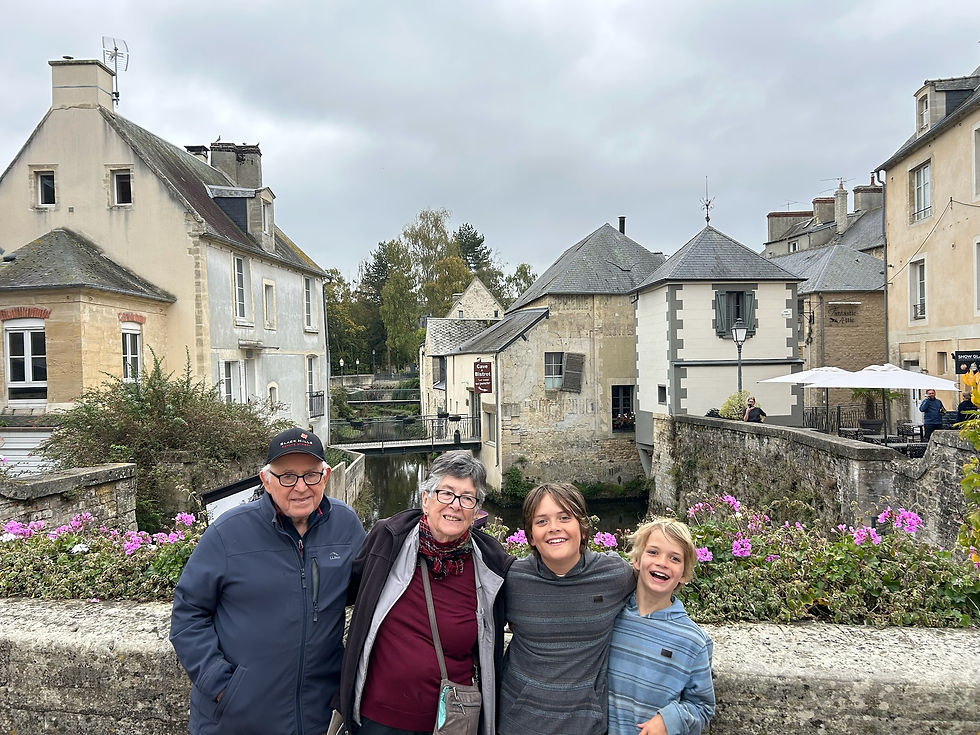
After Paris we travelled to Normandy with Grandma Karen & Dave - our first visitors from home! It felt so great to have this special time with them! We stayed in Bayeux - miraculously untouched by the bombings of World War II despite its proximity to the D-Day beaches. Including Bayeaux’s beautiful Catherdral which dates back to the 9th centruy. We stayed in the town centre making it easy to sample croissants each morning from different purveyors (Boulangerie des Ducs won out in case you are ever there). We visited Mont St Michel, a tidal island and abbey - the second busiest tourism site in France (after Paris). We learned this picturesque site only has 12 permanent residents (7 monks and 5 nuns). On down days we enjoyed the Bayeux pool on two occasions - this incredible public amenity in such a small town boasted 4 swimming pools (indoor and outdoor), a water slide and a full nordic spa for Ian & Erin (complete with saunas, steam rooms, warm and cold pools, and relaxation spaces). Only catch - no board shorts allowed - speedos only for men. The Sharp boys now have an extra item to pack! Thanks to Grandma’s presence Ian and Erin enjoyed a night out alone at a Michelin restaurant to celebrate their 16th wedding anniversary. Very blissful indeed!

An important history lesson
We hired Mike, a Dutchman with a refined English accent who has a passion for history to guide us through the sites and history of the D-Day landings and subsequent liberation of France. Dave and Ian’s knowledge of WW2 may be slightly above average but was still woefully inadequate when the kids started rapid firing questions during our tour; Mike’s ability to answer questions eloquently and in a manner that engaged Jasper and Finlay was amazing to watch. These events of 81 years ago helped turn the tide of World War II in favour of the Allied forces. The scale of this offensive is hard to grasp but with the help of our guide we learned much about the planning and implementation of this vast operation. We went to this region with hopes of learning more of Canada’s role in this part of the war. We were not disappointed.


Operation Overlord (the codename for the overall invasion plan)was the largest military operation in history and involved a massive combined air, naval, and ground assault that was supported by more than 12,000 aircraft and 7,000 naval vessels. Approximately 156,000 infantry, paratroopers, and armored infantry landed across the beaches on D-Day. Overall the allies suffered casualties of about 10,300 killed, wounded or missing in action. By the end of August 1944 there were approximately 2 million Allied troops in France. Although the cost of life was high, D-Day was the beginning of the long road to victory in WW2.
Canada’s Role
The events of June 6th, 1944 were not the first time that the Allies landed in northern France. Canada played a major role in an invasion that took place at Dieppe two years earlier. This earlier push led to a large loss of life and did not accomplish many of its objectives, although it did contribute good learning for further invasion planning. Although we did not visit sites associated with Dieppe it is a historically significant part of Canada’s role in WW2. Mike helped us draw the lines of connection between the two battles as we toured throughout the day.
We first visited Arromanches - this beach and town were strategically avoided from the bombings preceding the landings as it was earmarked to become a temporary supply harbour while the Americans and British captured more permanent sites further to the east and west. A large sea wall was installed by sinking large concrete blocks about one km out to sea which are still visible from the beach. These protected the artificial harbour from the worst of the weather on the English Channel giving the Allies the ability to build floating bridges to supply the offensive 24/7 in its earliest days.


Juno Beach
As we moved further east towards Juno Beach we found interesting and informative relics of the war on display along the coast. The one that the boys found most interesting was a tank that was modified to float! It was equipped with a canvas skirt that could be inflated so that the tank could float and a prop was installed on the driveshaft so that the tank could fire its gun on the way to the beach like a boat.
Juno Beach is one of five beaches along the northern coast of Normandy that were marked for the invasion by the Allies; the others being Utah and Omaha (American), Gold and Sword (UK). Interestingly the commonwealth sections were codenamed after fish while the American sections were given geographic locations. The original name for Juno beach was to be Jellyfish, however Churchill suggested that the name Jelly didn’t sound serious enough for the scale of the conflict and was therefore re-coded to Juno. The lessons of Dieppe influenced the planning of Operation Overlord. Canada’s earlier sacrifice was felt by those who were to lead the new invasion.
Canada House
Along Juno Beach right in the middle of where the invasion took place stands a grand two-storey house. This historic house became a landmark to Canadian troops landing on Juno beach on the morning of June 6th, 1944. The large timber framed house was visible to almost all the troops as they made their way from their boats to the sand of the beach. The house held a perfect strategic location overlooking the beach and English Channel and the Canadian troops were given orders not to destroy the house if able as the Allies wanted to take advantage of the building's strategic importance. This picturesque house was occupied by the Nazis from 1943-until the morning of D-Day when it was the first house officially liberated by the Allies. Sadly more than 100 Canadians were killed on the beach in front of the home in the first minutes of the invasion. It has become a place where many Canadians return to to pay their respects to Canadians who fought during the war. The house has been privately owned since the war but is decorated with Canadian flags as well as a large inukshuk on its steps, the boys enjoyed finding some flat stones on the beach to make their own.


Juno Beach Centre
We visited the Juno Beach Centre, a museum dedicated to the Canadian war effort. We found this visit to be fascinating! The museum was inaugurated in the early 2000s in time for the 60th anniversary of the landings and is home to some amazing exhibits. The museum's scope is not only just for D-Day but is meant to relate and showcase life in Canada leading up to the war as well as life during and after the outbreak of war. The veterans that the building was built to commemorate were specific in wanting part of the museum to display the reasons that they fought and sacrificed so much for.
The Sharps would like to make a special thank you to John who over the planning phase of our trip has been able to share his commitment and knowledge for Canadian World War history with us. Your enthusiasm is contagious; Finlay and Jasper have taken to this history enthusiastically in part thanks to your help. Many thanks for the books and advice helping us plan where and how to see this important chapter in Canadian history. John, we saw your name displayed at the Juno Centre as a contributing figure to its development. All Canadians thank you for your support of this important history.
The Abbaye
One of the more sad but fascinating visits was to Abbaye Ardenne on the outskirts of Caen. This Abbaye was a command post for a SS unit during the D-Day landing and was where a group of Canadian soldiers were held as prisoners before being murdered by the commander of the unit. He was later found guilty of war crimes in one of the first trials after the war. More information on this sad but powerful story can be found here.
Bény-sur-Mer Canadian War Cemetery
We set foot on home soil as the cemetery for 2,000 Canadian troops who died in Normandy are buried there; this land is officially part of Canada. This hallowed ground is beautifully kept and when we visited its maple trees were starting to turn their autumnal red. We took time to visit and read the gravestones, really bringing home for us the sacrifice of so many, at such young ages.

Our visit to Northern France has been wonderful. At times relishing in the hustle bustle of the city of lights-Paris, enjoying street festivals, art history, crepes, and wine! At other times slowing to learn of Canada’s rich history and to pay homage to Canada’s war veterans. We are now moving further south to find what southern France has to offer! Vive la France!
Don't forget to check our route page for more photos of our adventures!
Finlay
The amazing restaurants of France
I love French food in France because it tastes like nothing else. I had a ten day streak of eating croissants and the best one was from a patisserie in Bayeux. My favourite meal in France was one where we went to a pizza place with my grandma. My least favourite meal was when we went to a place in Paris. I had shrimps that still had the heads on and everything. I am also trying to order everything in french.
Jasper
I liked that there is so much to see like the Eiffel tower.
The most important thing that I learned about was world war two especially D-Day and Juno beach. I really liked seeing some grandparents in Bayeux.


Excellent blog. It was such a treat to join you for some adventures. The apartment you found absorbed us all really well, and gave us lots of stair climbing exercise. Erin’s morning runs always ended with bringing croissants home. 😀. We watched homework time, and saw the budget tracking process in real time. We’ll be able to picture both as you Stay Sharp and Travel Far. Love. From k
Amazing guys! I love reading these!
I am sure these memories will last forever. So much to learn and so much
Canadian history to appreciate.
Shout-out to Karen and Dave for making the commitment to making the trip exra special...
We are so enjoying reading about all of your amazing adventures! Happy Anniversary Ian and Erin, what a special one! xo the Coupers
What a fantastic read! Thank you so much for sharing your experience with us! Congrats Ian and Erin, an anniversary to remember xo