SafariLife


Pole Pole
It is hard to put into words the magic of safari in Tanzania. We came out of the bush tired, dust covered and delighted by all that we saw and experienced. This was a wow for each of us - keeping us individually and collectively engaged and interested throughout. This will be a memory that we will all keep with us.
*There are videos uploaded into this blog post be patient with the loading
Our supreme leader, Boniface, is a 20-year veteran of safari guiding - having worked for some of the big companies but now running his own. We benefitted so much from his knowledge – of the wildlife, the local areas and people, the great places to stay… also for the care and dedication that comes from a business owner. Importantly, it also means more of our money stays in Tanzania than if it were paid to a foreign-owned operator (which some of them are). We were fortunate to find Boniface thanks to word-of-mouth recommendations (thanks Dean & Jesse!). He was with us throughout our 8-day journey and we all miss seeing Boniface, and hearing his many expressions peppered in the narrative below.


Safari is done in a safari truck – and the boys were delighted even with this. A rugged, specially designed version of a Toyota Landcruiser, these trucks are outfitted with pop-up roofs “African A/C”, 3 rows of comfy captain chairs, custom shelving for drinks and binoculars, and two super-sized fuel tanks and durability that can handle off-roading over bumps “African massage” when you are on the hunt for an animal sighting. The truck took us on daily (and sometimes twice daily) game drives as well as transporting us between the five different places where we would ‘kiss the pillow’ after a long day.
Tarangire
We began in Tarangire National Park, a ~2,000 square kilometre park close to Arusha, and found success on day one spotting lions on an (unsuccessful) hunt, elephants (with babies in tow), leopard (hard to spot), buffalo, and many giraffe, zebra, wildebeest, and warthogs. We would also be introduced to the superb starling (its actual name), a stunning east African bird with turquoise plumage that we would see everywhere.
A stork Termite mound African A/C Leopard in a baobab tree
We then spent two nights near Karatu. The first day, we woke early to go hunting with a group of bushmen – nomadic people - who taught the Sharp men how to hunt with bow and arrow, cook and eat your prize (in this case a small bird which when cooked tasted like a chicken wing). We also visited a traditional Maasai village, learned some of their dancing and music, finding that white men truly can’t jump. A large part of their dancing and hunting rituals involve a showcase of airtime seemingly able to float above the ground. Ian's pitiful attempts at airtime were happily mocked by the colourfully dressed Maasai, all in good fun. Our day finished with a tour and visit at the Maasai Girls Rescue Centre – an organization working to house and educate girls who would otherwise end up in an early forced marriage or other difficult circumstance.
Finlay swapped headgear with a hunter Playing a silly game with some Maasai The lodge had a farm with rabbits
Ngorongoro Crater
The following day we visited the Ngorongoro Crater, the world’s largest unfilled volcanic caldera (collapsed volcano). This place is incredible – from the stunning views from the upper ledge overlooking the crater, to exploring the basin, the volume and diversity of the wildlife here is impressive, with Boniface teaching us the Swahili name for each including elephant (tembo), giraffe (twiga), many types of antelope, zebra (pundamilla), vultures and cranes, wildebeest (nyumbu), ostrich, monkeys and many species of birds. During our descent into the crater, Boniface spotted some antelope running – and we looked uphill to find a mother lion (simba) with 3 tiny cubs in tow that had spooked the antelope. They passed right beside our truck, close enough that we could hear the cubs squeaking. Our luck continued as we spotted our only rhinos of the trip (these are the rarest of the big five in East Africa) – we were able to see ten of them including several babies.
Boniface pointing our rhinos from a distance Boniface called these the "Maasai Landcruiser" Rhino-hard to get closer Grey crowned crane Norgorngoro viewpoint
Ndutu Area
We then travelled further into the Ngorongoro Conservation Area (over 8,000 square kilometers of protected area) on copper coloured dirt roads that weave through rolling mountain grasslands used by the local Maasai to graze their cattle, passing remote Maasai villages, then across savannahs to arrive at the first of two bush camps we would stay in. We stayed for 3 nights here in the Ndutu area – our primary mission to witness the wildebeest migration during calving season which also brings out many other animals, including predators. Over 400,000 (!!!) wildebeest travel in this part of Tanzania each year, with virtually all females giving birth. We witnessed the birth of one wildebeest, and the first steps for several calves. Everywhere you look there are births, young ones and thousands of herds travelling. Only about 20% of wildebeest young survive, some being separated from their herd during stampedes or by predators that prey on the slow easy targets. Needless to say we saw many examples of the circle of life. As a conservation area, instead of a National Park, you are able to drive “off road” on game drives, giving you a unique ability to get up close wherever animals can be found. Here we established more of a game drive “routine” – early morning and late afternoon “pole pole” (no rush) drives with a nap in between during the hottest part of the day. We would often have a picnic breakfast packed for us to enjoy in the morning and enjoy a cold beer at sunset in the afternoon as we watched animals travel, hunt or laze in the shade. Here we were able to see the most animals all together – and we learned they all have unique names: pride of lions, parade of elephants, tower of giraffes, school of hippos, dazzle of zebras….congress of baboons, feel free to read into that all you want!
What is a bush camp like you might ask? We were delighted to discover these are semi-permanent or permanent set up consisting of large, multi-room tents that include real beds, full bathrooms, on demand hot showers, separate lounge and dining tents and lovely staff teams. These are not fenced – rather you have to be accompanied back to your tent after dark to avoid the hyena, hippos, elephants or others who may be wandering through camp. You fall asleep to the sounds of animal calls. Our understanding is that bush camps can be every level from ultra-luxury to very basic – the Sharp team landed somewhere in the middle.


Serengeti
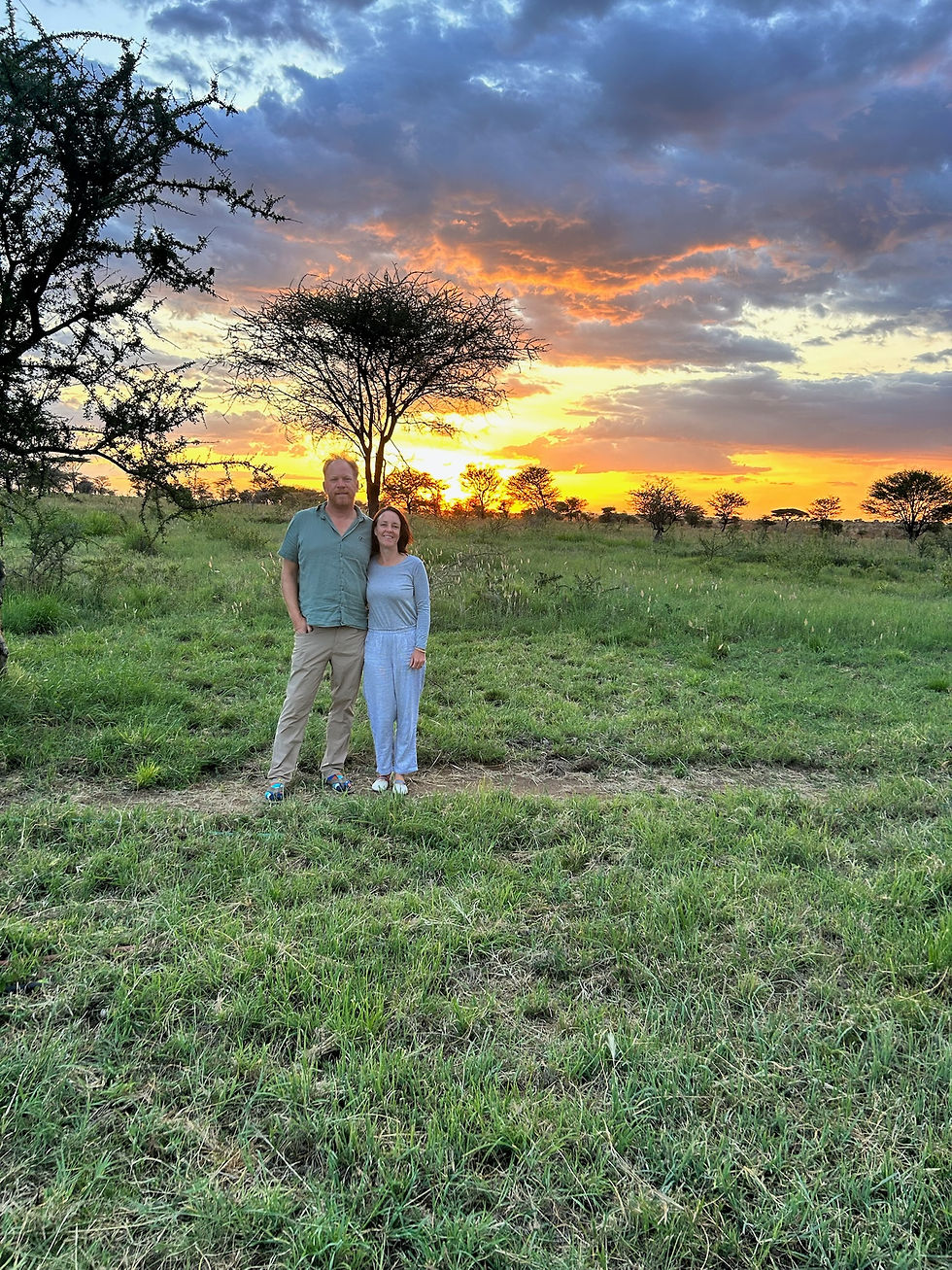
From Ndutu we travelled to the famed Serengeti National Park (14,000 square kilometers of park) which did not disappoint. Fears that we might get bored on days seven and eight were unfounded to say the least. The team enthusiastically kept up our long days in the safari truck to see all we could. The pay off was seeing the biggest pride of lions even Boniface had ever seen after a multi wildebeest kill. The 30 odd lions from young cubs to elder lions and lionesses were everywhere! There was even a lion couple a little further away on their “honeymoon” , a time when the couple tried to find some privacy away from the pride. We also managed to see an elephant parade of over 50 elephants travelling all together, another leopard, a family of cheetahs and the most stunning, iconic vistas of acacia trees on the savannah at sunrise and sunset.
Leopard in the tree The honeymooners Family of cheetahs Leopard in the tree Breakfast break Giraffes are funny when they run
We said goodbye to Boniface on day nine and boarded a flight from Serengeti dirt strip to Zanzibar via Arusha. We left safari feeling awed by animals, the conservation efforts that are required to protect these amazing places, the expansiveness and breadth that Tanzania offers, and a love for the people who welcomed us so warmly.
Finlay
The safari was one of my favourite times in the whole trip because I got to see animals that you can't find anywhere else in the world. I loved seeing all the animals. My favourite one to see was definitely the lions. They were so cool and strong. I also loved seeing all the other big five. Which are the lion, rhino, elephant, leopard and the buffalo. We saw 83 lions in total during the whole week. We also saw 4 leopards, one of them was dead. Then we saw 10 rhinos. You can only see rhinos in one spot in Tanzania and that's the Ngorongoro crater. Then we saw too many elephants and buffalos to count because there are so many of them. One time I counted a parade of elephants and I counted 51 elephants in the parade.Our safari guide was amazing. He knew just where to find a whole lot of animals. I highly recommend him.
Jasper
The safari was maybe my favourite part of this whole trip. My favourite animal was the elephants and Boniface was the best tour guide in the entire continent. We had a joke that I was a Poomba (warthog) that snorted a lot and his favourite animal is the Duma (cheetah) because it is very peaceful. We saw the big five and the baby big five. It was the cutest thing in the whole world.


You’ve seen so much!!! Those lions and the wildebeest migration was amazing! So excited for all of you!!!
Just incredible!! Thank you for sharing your experience, I had a smile on my face the whole time!! Amazing!!
So great to see you all having such fantastic experiences!
Incredible! What an incredible adventure that I loved reading about along with viewing the stunning photos and videos.
Your pictures are amazing and you were able to see so many animals!! Enjoy your continued adventures!!